
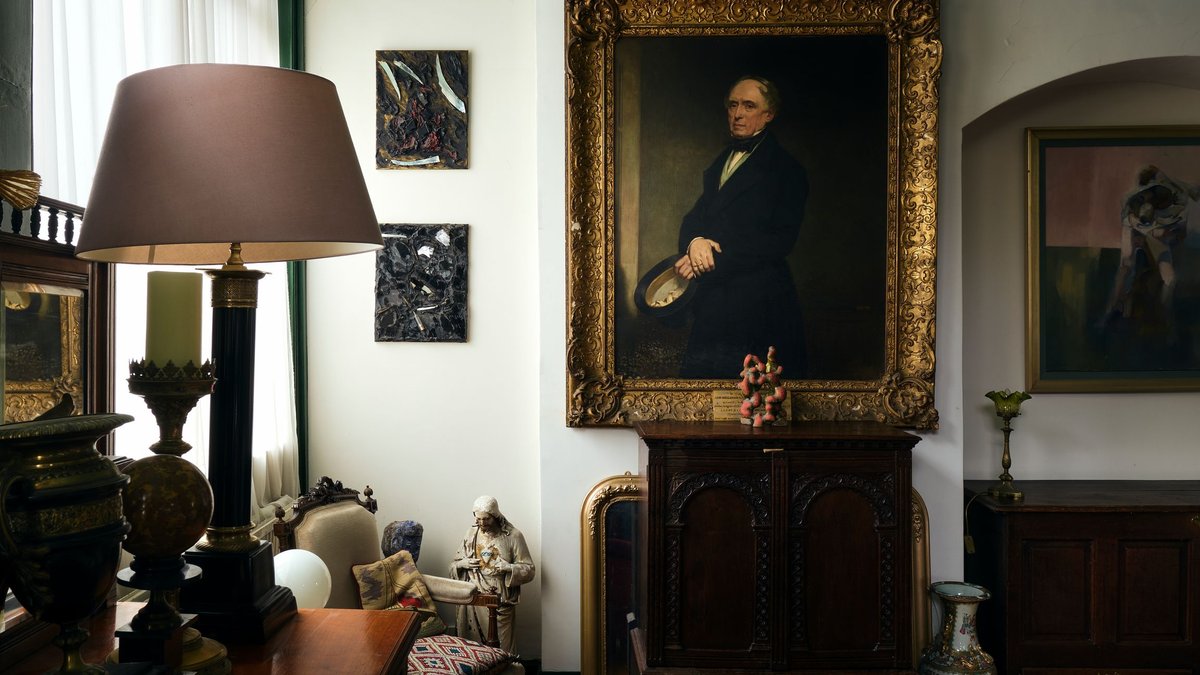
British filmmaker Julian Cole has spent decades collecting objects and stories, a passion now deeply embedded in his restoration of the historic Cable Street Inn in East London. The establishment, a former 18th-century pub, stands as a tangible archive of Cole’s personal history and artistic influences, housing a curated mix of salvaged materials and family heirlooms.
The interior of the Cable Street Inn reflects the varied career of its owner. A reproduction of the artwork in which Cole appears hangs in the stairwell, a nod to his time as a model for Gilbert & George. He later collaborated with the artists on the 2008 documentary With Gilbert & George, a project that drew inspiration from their Spitalfields home. In the living room, a mirror fitting from a Meux & Co ale house displays the text “Saloon Bar,” while the breakfast room features early 19th-century wallpaper dated to around 1810.
Throughout the house, objects tell the story of the building’s past. Shards of Roman amphorae, 17th-century clay pipes, and 19th-century ginger-beer bottles have been excavated from the garden. This collection of debris and detritus is intentional, mirroring the aesthetic of Derek Jarman’s nearby Prospect Cottage and the salvaged materials of the House of Beauty and Culture collective.
Julian’s approach to renovation differs from typical commercial conversion projects. Instead of knocking down the market, he preserved the building’s character. The floorboards, original fittings, and exposed layers of paint are all kept intact. This preservationist stance has allowed the space to retain the “liquid light” and textured atmosphere found in his earlier work, such as the 1987 film Ostia, which transposed scenes from Rome to the sooty streets of East London.
Related: Entries Closed: World of Interiors x Montblanc Open Call for New Writing 2026
In a setting where historic properties are frequently divided into flats, the Cable Street Inn remains a single family unit. The choice to keep the property intact is as much about practicality as it is about preservation. With a lifetime of art and furniture accumulated from travels across China, Russia, and the Middle East, the space is simply too full to be subdivided.
A history written in the walls
Living in the space has given Julian a unique perspective on the layers of history beneath his feet. The proximity to the railway line and the Georgian architecture creates a specific atmosphere that he finds conducive to creativity. He believes the building itself acts as a curator of stories, referencing figures like Charles Dickens or Oscar Wilde, who may have passed through the same ale house centuries ago.
The artistic environment Julian cultivated during his youth continues to inform his daily life. His mother’s time in a former monastery and his upbringing in a falling-down Victorian house in Islington taught him to appreciate the beauty in decay. He views the peeling paint and draughty rooms not as flaws, but as features that connect the present to the past.
Despite the restoration work, the inn retains its function as a traditional bed-and-breakfast. It sits on the edge of central London, a location that has seen increased foot traffic due to its proximity to the 2012 Olympic Park. For Julian, the inn is not just a business, but a vessel for the “stories” and “layers” that he has spent a lifetime gathering. Seven standout designs unveiled at Milan Design Week


