
Carolina Irving’s Paris apartment reflects a lifetime of travel, trade, and deep appreciation for decorative objects. The rented flat in the 16th arrondissement overflows with textiles, ceramics, and paintings—each piece selected for its emotional resonance rather than monetary value.
The space serves as a living archive of her interests.
The crest that anchors the collection
Irving would save one item above all others: a Venezuelan coat of arms made entirely of feathers. She found it folded in a paper bag at Sotheby’s. When unrolled, the symbols were unmistakable—cornucopias, a wheat sheaf, tools, weapons, and a galloping horse, all framed by laurel and palm branches. The design originated in 1864 under a new constitution, and this version was crafted from hundreds of feathers, likely sourced from Venezuela’s diverse bird populations.
In a 2007 interview, she noted her country’s rich avian biodiversity. The crest now hangs in an octagonal green frame, its colors lively against the entrance hall’s yellow walls. It doesn’t just decorate the room; it redefines what a home can contain.
Related: Filmmaker Julian Cole Reframes East London’s Cable Street Inn
A lifetime of layered obsessions
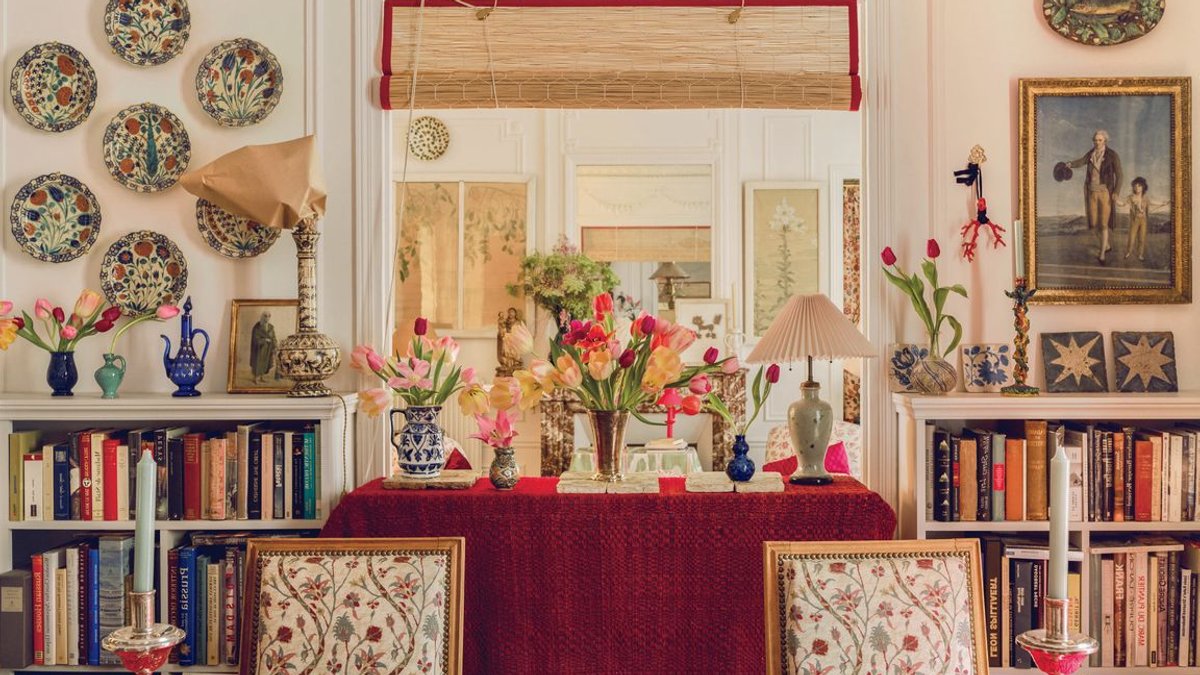
The apartment mirrors Irving’s evolving passions. The dining room, once divided by double doors, now centers on a crimson velvet table blocking the passage. A sofa placed against it creates a cozier arrangement. She initially considered floor-to-ceiling bookcases but abandoned the idea to leave space for the objects she cherishes. Instead, she installed half-height shelves, using the tops to display ceramics, glass, and small paintings in rotation.
Her current fascinations span antiquity, Ottoman and Middle Eastern artifacts, grand Eastern European estates, travel writing, and historical biographies. The sitting room celebrates gardens, while the basement stores overflow pieces awaiting their turn in the spotlight.
Color plays a key role in the design. The dining room walls showcase 17th-century Hungarian plates, their surfaces adorned with tulips from a period when the country maintained strong ties to Turkey. Elsewhere, a Mughal dish glows with mother-of-pearl, and Córdoba tiles radiate deep blue star patterns. Lighting became its own project after she struggled to find lampshades she liked. She adopted a technique from photographer François Halard, folding craft paper into delicate shades for bone lamps from India.
This borrowing—from history, cultures, and friends—defines her aesthetic. A painted wood fragment from an Athens gallery sits among Ottoman vases and tulip phials. A portrait of a Turkish woman, so finely detailed it resembles Jean-Étienne Liotard’s work, came from Boubker Temli 30 years ago. Every item carries a story, and each story finds its place in the apartment.
Related: Why Black Figures Endure in European Decorative Arts
The effect resembles a cabinet of curiosities more than a museum. Walls bristle with paintings and textiles, surfaces teem with ceramics and glass. Real tulips mingle with their porcelain, glass, and paper counterparts, creating a deliberate yet untamed burst of color.
The apartment isn’t just a home but a chronicle of Irving’s life and those around her. Portraits of her daughters, Olympia and Ariadne, painted as infants by artist Elliott Puckette, hang on the walls. The arrangement follows no strict timeline or origin; instead, pieces are grouped by how they converse with each other and with her.
This collecting style stands out in an era that favors minimalism or sparse interiors. Irving’s home rejects those trends—it’s full without feeling crowded, personal without sentimentality. The space feels authentically lived-in, where every object has earned its place through years of careful selection and rearrangement.
Standing in the sitting room, she admits, “I am endlessly nostalgic. I don’t like the modern world. I feel I am being pulled back to the past, constantly.” The apartment becomes her way of bridging that gap, bringing history into the present one feathered crest, one painted tulip, one bone lamp at a time.


