
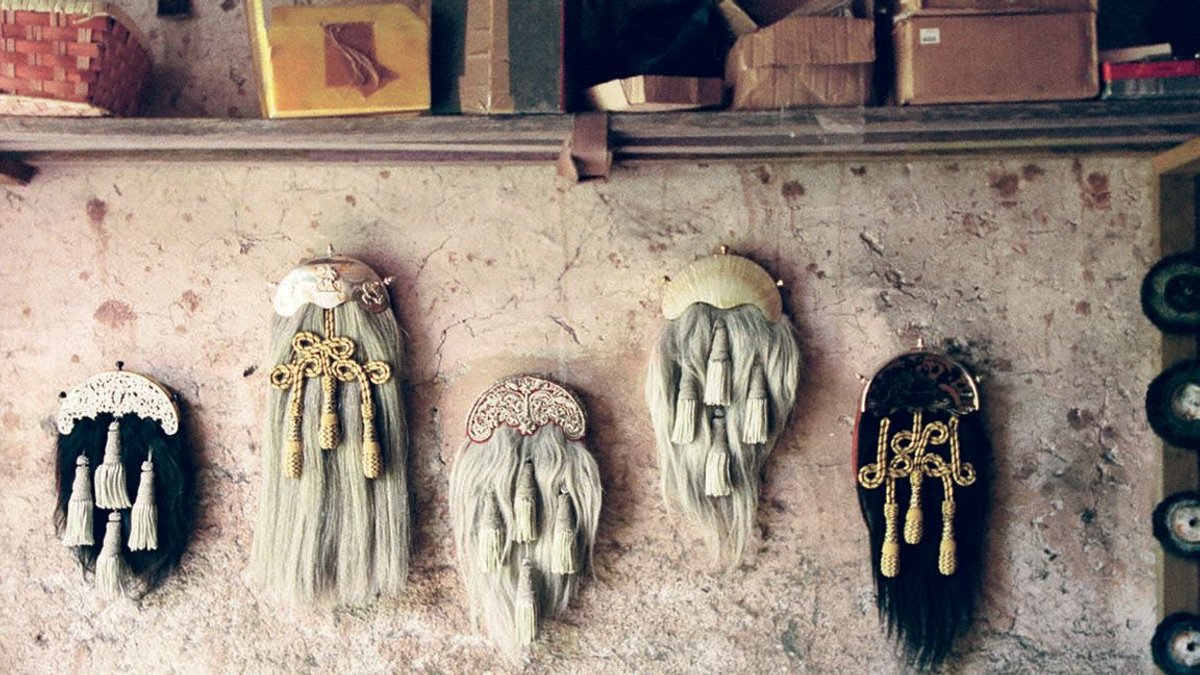
Monty Lewis creates clan-tastic sporrans from a workshop in the English Lake District. The sporran is a traditional Scottish accessory that hangs from the front of a man’s kilt, serving as a replacement for pockets. While modern kilts usually have pockets, the sporran remains a vital piece of Caledonian dress. Lewis, who grew up in London but claims Scottish heritage, now handcrafts these leather pouches with a specific focus on clan tartans and historic aesthetics.
Lewis’s interest in the garment stems from his childhood. He attended a boarding school on the Isle of Skye, where boys wore their family tartans to church on Sundays. He recalls that the kilts rarely fit well and looked more like miniskirts than proper Highland dress. He cherished his own sporran, a stuffed otter’s head with a hole in one ear, which he believed was a World War II casualty. He now suspects the damage was caused by moths.
The device has evolved from a practical tool for carrying valuables in pre-pocket times to a ceremonial item. Lewis describes the connection Scots have to the sporran as visceral. He notes that wearing a kilt without one is considered odd. He inherited his mother’s shop, VV Rouleaux, which sold trimmings, and used to play in a basket of ribbons while wearing his Royal Stewart kilt. This early exposure to the materials of Highland dress supported a lifelong fascination with the craft.
Despite growing up in London, Lewis felt a strong genetic pull toward his Scottish roots. He claims his great-grandmother was a chieftain of the MacIntyre clan, though his research suggests she was actually born in America. He believes this romantic obsession runs in the family. His workshop is located in a 1823 Cumbrian barn near the River Derwent. The space is open to the elements, which can make it cold in winter, but he prefers it for the heavy work.
From Ship Rope to Silver Wire
The designs for Lewis’s sporrans often draw directly from the natural setting and historic ephemera surrounding him. He sources hides from Galloway cattle on the local fells for the pouches. He captures the movement of wind on water while fishing and translates that into hammered-silver cantles, the front plate of the sporran. He keeps a close watch on old riverside oaks, waiting for storms to fall so he can salvage the wood for carving.
He views his environment as a mine for ideas. A rope from an old ship inspired a silver-wire belt for a sporran, replacing the standard leather strap. He finds fascination in the engineering of his grandfather’s wool mill ledgers, specifically the spines, which influence his stitching techniques. His background in design and silversmithing at Northumbria University informs how he understands how things are made. He picks apart historic objects to see what they could become.
While the sporran traditionally covers the area of the body known as the groin, Lewis approaches the sizing with a sense of humor rather than strict measurement. He observes that the broader the man, the bigger the sporran must be to look proportionate. However, he admits he does not take actual measurements, trusting his eye for the balance and silhouette of the finished piece.
Modern culture has shifted away from the chaotic energy of house parties, yet the ritualistic nature of dressing remains strong for many. Lewis’s work honors that tradition through tangible objects. He recently completed a commission for a client who wished to wear a sporran that mimicked a Kent house interior. The result was a complex piece that combined architectural elements with the utility of the pouch.


