
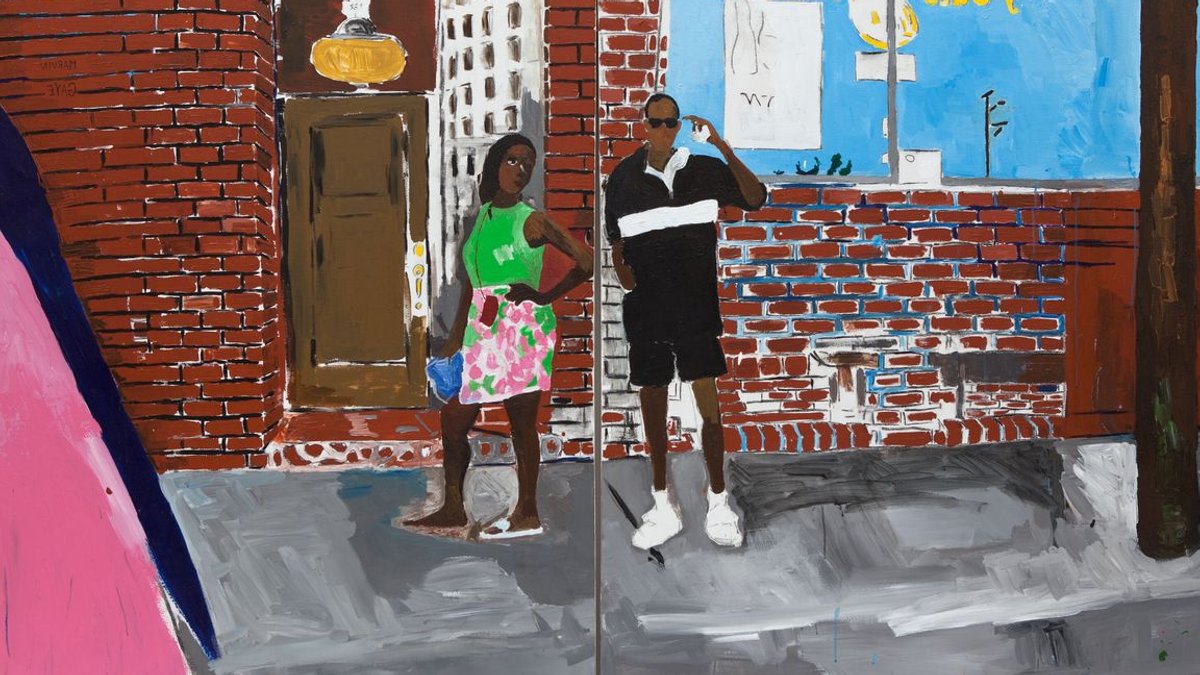
Art lovers in Paris have a limited window to witness a striking dialogue between two generations of artists at the Musée National Picasso-Paris. An exhibition that opened in April invites visitors to consider the connection between Henry Taylor (b. 1958) and Pablo Picasso (1881–1973). The display marks the first retrospective of Taylor in France, bringing his portraits into the institution devoted to modern painting’s most mythologised figure. The show runs from 8 April to 6 September 2026.
Five Women and a White Arm
The exhibition highlights a specific work from 2007: From Congo to the Capital. Taylor painted this piece on a wooden shipping crate using gestural acrylic and impasto. The canvas depicts five Black women from destabilised perspectives, echoing Cubism’s disruption of natural representation. The composition feels compressed, almost stage-like, with the figures pressed forward into the viewer’s space. At the centre stands a woman with a sharp bob; she represents the dancer and actor Josephine Baker.
A disjointed white arm thrusts into the composition. This abrupt, unsettling gesture hints at the persistence of racialised power within Western visual culture. The limb appears without a body, a partial presence exerting force that interrupts the rhythm of the figures. With the mention of Congo in the title, Taylor gestures toward colonial histories, binding together Africa, Europe and America in a 21st-century frame.
A Century Apart, Akin in Spirit
When viewing the work closely, Picasso’s Les Demoiselles d’Avignon comes clearly into view. In both paintings, five women are compressed into a shallow, almost claustrophobic space. Bodies distort: noses sharpen into wedges, limbs twist and waists form angular shapes. While the origins of Picasso’s work are debated, his encounters with African sculpture in Paris are often cited as formative.
Here, the comparison shifts from mere visual similarity to thematic weight. Whereas Picasso rendered his figures as fractured forms, Taylor’s forms have psychological and physical weight. Flesh remains flesh; his subjects do not dissolve into geometry. His intervention in the Western canon raises questions about what it means to place Black women at the centre of a composition that was once hailed as Modernism’s turning point. The comparison suggests that while the formal language of abstraction has evolved, the struggle to represent Black subjectivity remains a central tension in art history.
Related: Monty Lewis Creates Clan-tastic Sporrans
For authors such as Richard Wright and Chester Himes, Paris became a temporary reprieve from the violence of anti-Black racism in America—a capital city both liberating and watchful, hospitable yet never entirely neutral. Taylor’s work bridges this geography and time, situating Baker and others within a lineage that challenges the traditional canon.
Over four decades, Taylor has excavated the nuances of the human condition through both two- and three-dimensional works, while resisting the label of ‘portraitist’. This encounter is about lineage and influence as well as proximity. It is about what happens when a contemporary artist of lived Black experience occupies the rooms of modern painting’s most mythologised figure.
Returning to the Source
The inclusion of Taylor follows recent exhibitions of American artists such as Philip Guston, Faith Ringgold and Jackson Pollock. These presentations suggest a growing recognition of artists who have historically been marginalized. The juxtaposition of Taylor with Picasso offers a different kind of conversation than those between American contemporaries. It places Taylor within the lineage of European modernism itself, forcing a re-examination of where that lineage begins and ends.
Visitors might also draw parallels between Taylor’s work and the artistic output of Pablo Bronstein, who has similarly reimagined historic domestic spaces through a contemporary lens. [2] Bronstein turns Kent house into art haven explores similar themes of architectural reinterpretation and historical reclamation.


