
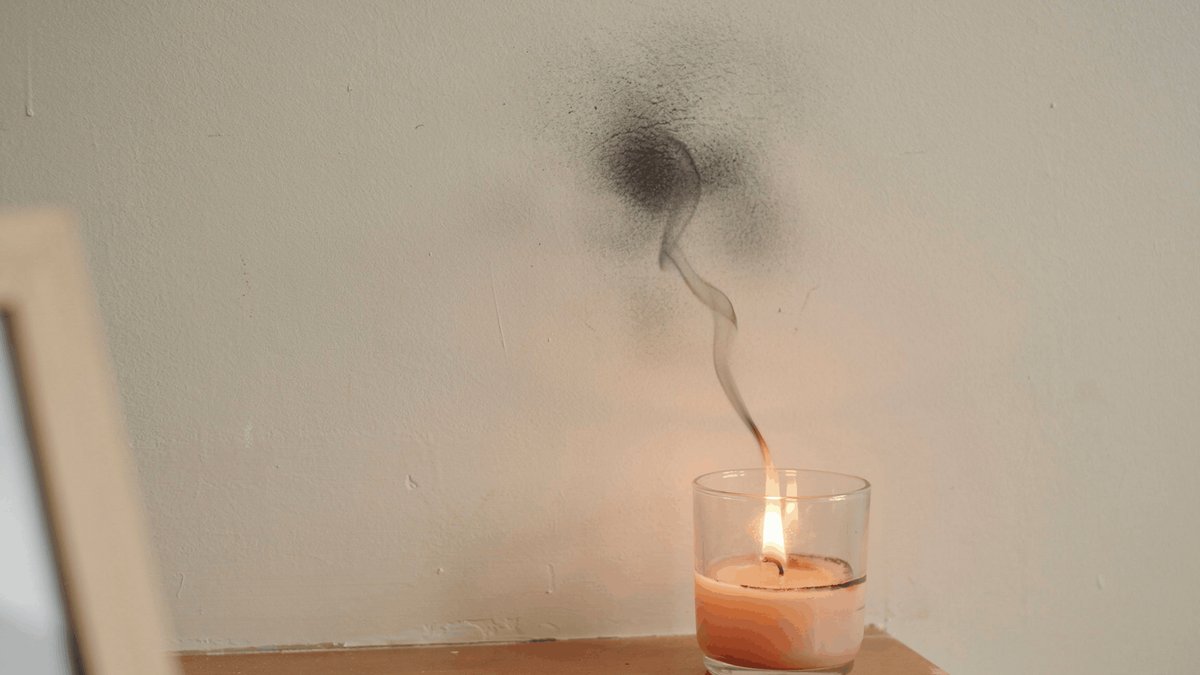
That faint gray shadow on the ceiling above your favorite candle isn’t a sign of cheap wax. It’s soot—tiny black particles released when a candle burns inefficiently, clinging to walls, lampshades, and picture frames.
The real problem isn’t the candle
Most people blame black marks on low-quality candles. The issue, however, lies in how the candle burns. When a flame flickers or struggles, it releases soot—the same fine black powder found in car exhaust or furnace emissions.
A properly burning candle turns wax into invisible gas and water vapor. An unstable flame, though, allows tiny soot particles to escape into the air. These particles ride warm air currents upward, settling on cooler surfaces like walls. Flat paint, with its slight texture, traps them especially well.
A 2021 study in Indoor Air found that flickering flames, wick deformities, and drafts increase soot emissions. Later research in Scientific Reports confirmed that unsteady flames release far more harmful particles than steady ones.
The particles include PM2.5—fine dust small enough to bypass nasal filters and lodge deep in the lungs. The EPA notes that indoor air is often two to five times more polluted than outdoor air, and Americans spend about 90% of their time inside. A poorly burning candle in a closed room for just four hours can worsen air quality.
Why longer burns make it worse
A candle works like a tiny fuel pump. The flame melts wax, the wick absorbs it, and at the tip, the liquid wax vaporizes and burns. When fuel and air are balanced, the flame stays small and teardrop-shaped, producing little soot.
Related: Towels Not Absorbing Water Properly
As the candle burns, the wick grows longer. A too-long wick absorbs more wax than the flame can consume, forming a black “mushroom” at the tip. This mushroom makes the flame taller, hotter, and shakier, sending puffs of soot into the air with every flicker.
The melted wax pool also becomes an issue. After three or four hours, it overheats, causing the flame to flare and pull up even more fuel. Companies that clean fire and smoke damage for a living say the dirty streaks that look like years of grime can build up in a single evening of improper burning—even with high-end soy or beeswax candles.
The marks on walls aren’t just dirt. They show a flame that grew too large, too hot, and too fuel-rich for too long.
The difference between candles that leave walls spotless and those that coat them in black isn’t the price. It’s the burn.
The solution doesn’t require expensive tools or new candles. Small, consistent habits keep the flame steady and the air clean.
How to burn a candle without ruining your walls
Trim the wick to ¼ inch before every burn. A short wick keeps the flame small and prevents the mushroom effect. This step alone can extend a candle’s life by up to 25%.
Related: Is multi-level decking still a smart investment
Limit burns to three or four hours, then let the candle cool for at least two hours before relighting. After four hours, the wax pool overheats, the wick deforms, and soot production rises. The two-hour rest lets the wax and wick reset.
Avoid drafts. Keep candles away from open windows, AC vents, and ceiling fans. Moving air makes flames flicker, and every flicker releases soot. If the flame won’t sit still, move the candle to a calmer spot.
Extinguish the flame properly. Don’t blow it out—this sends a burst of smoke and unburned wax into the air. Use a snuffer, a wick dipper, or the back of a spoon to smother it cleanly.
Maintain at least 12 inches of space between the candle and walls. The closer it is, the less room sooty air has to disperse before hitting a cool surface. For three-wick candles, these rules apply to each wick.
After a month of these habits, the black ring on your jar lid will stop forming. The flame will burn low and steady instead of jumping. The gray shadow above your candle spot will stop spreading. That $30 candle will finally last as long as promised.
The key isn’t buying a better candle. It’s burning the one you have correctly.


