
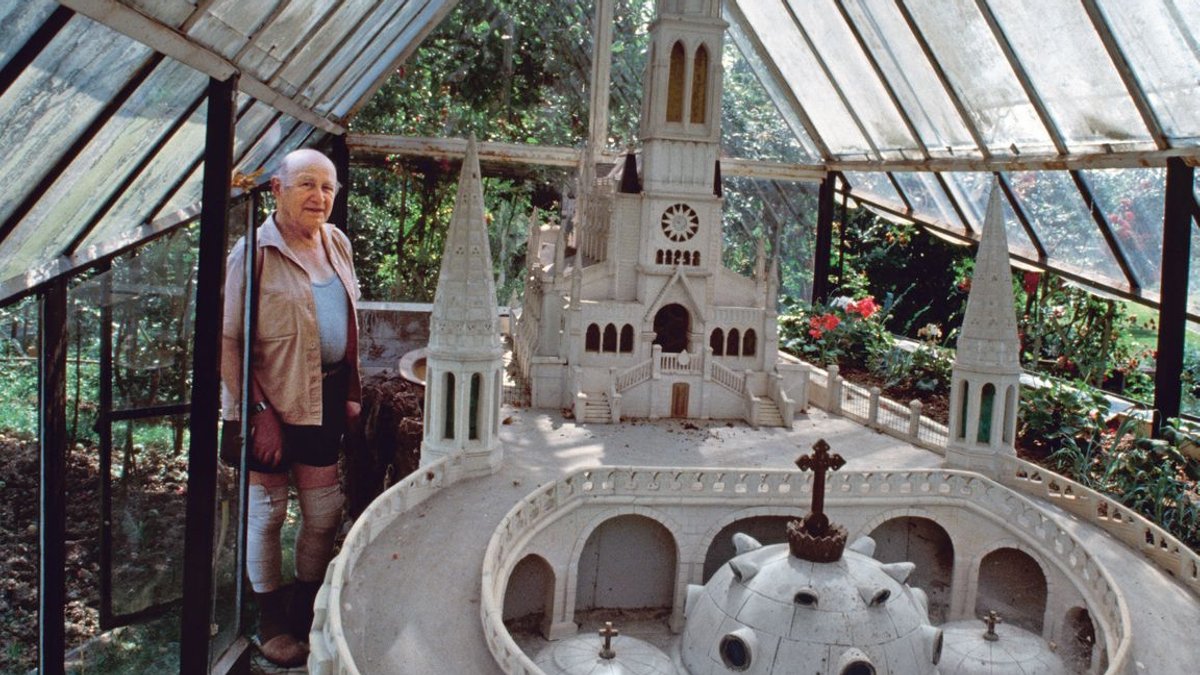
Francis David’s new book, Un Monde Parfait, captures something rare: the quiet revolution of people who turn emptiness into art. Between 1978 and 2025, he photographed homes in France where retirees, grieving widows, and those adrift from routine transformed their surroundings into living sculptures. Broken dishes became mosaics. Lawns sprouted miniature Eiffel Towers. Walls dissolved into naive frescoes.
These weren’t hobbies—they were responses to rupture: a death, a divorce, a sudden stretch of idle time. For many, the turning point came when a single discarded object—a chipped plate, a scrap of metal—sparked an idea, and soon entire rooms were reshaped by the hands of their creators. And then, one day, the materials arrived, scrap metal, discarded tiles, plastic toys, and the world remade itself around them.
The photographer didn’t set out to document outsider art. He was drawn to the act of inhabiting it. Many of these spaces, like Raymond Isidore’s Maison Picassiette, a house sheathed in shattered crockery, are already lost. After their creators die, the works often vanish, dismantled or scattered. David knew this. He’d spent decades chasing these places, starting with Isidore’s home in 1977, where a pile of broken plates became the seed for something far grander.
The discovery of these worlds often began with whispers: a neighbor’s remark, a fleeting mention in a local paper, or the reputation of a “madman” in a nearby town. Later, he followed rumors of a “madman” in Châteaudun, only to find M. Jaffrenou building a spiral staircase from cement, one bag at a time. Each discovery deepened his obsession: not with the art itself, but with the lives that birthed it.
Art That Resists Categories
By the time Un Monde Parfait was published, David had amassed 2,200 slides of these worlds. He donated them to Lisse’s LAM museum, but not as relics. The book’s editor, Estelle Hanania, and essayist Baptiste Brun frame it as an argument: these spaces aren’t just art brut or outsider works. They’re something messier. Brun writes that they borrow from masonry, from political murals, from the detritus of daily life.
Lucien Favreau’s painted room in Yviers holds both a hand-modeled Rodin-esque thinker and a Treblinka mural copied from a Paris Match photograph. The tension between the sacred and the banal is deliberate, some creators used religious imagery alongside mundane household objects, blending devotion with the everyday. David refuses to categorize. These places resist labels because they resist being contained.
What unites them is the way they blur the line between maker and environment. A two-meter-tall nude sculpture isn’t just art, it’s part of the room’s air. A miniature village isn’t decoration; it’s the environment. David’s photographs don’t isolate objects. They show people half-buried in their own creations, surrounded by half-finished projects and raw materials. The effect is intimate, even invasive. You’re not looking at art. You’re looking at a life that’s become its own medium. In many cases, the creators lived among their work for decades, their daily routines intertwined with the ongoing transformation of their spaces.
From Broken Plates to Plastic Trucks
David’s own career mirrors this search for the overlooked. He taught photojournalism for 30 years, specializing in portraiture and reportage, but his real subject was always the same: things and people dismissed as unremarkable. Earlier projects, writers at their desks, British shop fronts, revealed patterns in the ordinary. Un Monde Parfait is his most ambitious attempt to do the same for these self-made worlds. Yet even here, he resists easy conclusions.
The book includes a 2025 update, where he returns to France to document six new makers. Salvage culture has evolved. Now, it’s plastic toys, vintage souvenirs, scale model trucks. One man, Louis Ames, has assembled a collection of scale replicas of American trucks in his home in Hirel, never having set foot in the U.S. David playfully proposes a new category for these works: habitants paysagistes, or what he calls Art Gifi, a term referencing the French discount chain known for its bric-à-brac.
The institutional response to these works has been mixed. Some sites survive as kitschy hotels or restaurants. Others, like works by Josué Virgili, are preserved in museums, but David warns that removing them from their original contexts is an institutional dilemma akin to “showing one square centimetre of the Mona Lisa.” Lille’s LaM now keeps a room dedicated to habitants paysagistes, but the gesture feels incomplete. These spaces weren’t meant to be curated. They were meant to be lived in. David’s own encounters with these places often left him struck by how deeply the creators’ identities were woven into their work, each room told a story of who they were and what they had endured.
Why These Worlds Feel Perfect
David’s hope is simpler: to make readers pause. As they flip through the book, he wants them to lose their preconceptions about art. Not to learn a lesson, but to feel something. The makers he photographs aren’t seeking validation. They’re building worlds because the alternative, empty time, grief, isolation, is unbearable. The book’s title, Un Monde Parfait, isn’t ironic. It’s a description. For these people, the imperfect is the only thing that feels complete.


