
Victor Horta, the founding father of Art Nouveau, started an architectural movement with his first-ever building, thanks in part to the trust and support of a loyal friend, Eugène Autrique. Born in Ghent in 1861, Horta graduated from the Royal Academy of Fine Arts in Brussels, where he joined the Freemasons and met Autrique, a mechanical engineer, in 1888.
At the time, the architectural style in newly independent Belgium was Eclecticism, characterized by rapid urbanization and a diversity of new buildings with creative, colorful, and stylistically blended façades. However, Horta’s development of Art Nouveau expressed a push for nature-inspired, decorative unity and technical innovation serving an artistic purpose.
Early Career and Influences
Horta’s vision and abilities were believed in by Autrique, who gave him his first free-rein project in 1893: a ‘modest’ family home. As the budget was tight, Horta scaled down his fees, and the cost of the exterior came from his own pocket. The house, known as Maison Autrique, featured curvatures and distinctive white-stone courses, which would become a staple of Horta’s later works.
In the vestibule, a mosaic floor of red and white marble unfurls, with a pattern winding and folding, and the banister seems to sprout from the floor and grow, twisting towards the light from the stained glass at the first landing. Horta’s maxim, ‘It is not the flower that I like to take as a decorative element, but the stem,’ is reflected in the design.
Maison Autrique and Art Nouveau
Above a doorway flanked by articulated pilasters sit four panels of stained glass representing a persimmon tree and lilies, and four panels portraying a flight of herons in a cloudy sky. Horta is thought to have been influenced by a collection of Japanese art owned by Emile Tassel, another friend and client. The Hôtel Tassel, finished shortly after the Autrique project, is one of the most celebrated examples of Art Nouveau architecture.
Restoring Art Nouveau Glory
Over the 100 years after it was built, Maison Autrique underwent many transformations until it was acquired by the municipality of Schaerbeek, which obtained funding to embark on a careful restoration and preservation of the building. The restoration, led by architect Francis Metzger, a specialist in heritage restoration, aimed to revive the property to its former glory.
Related Post: Tamart Design Story Born of Love
Restoration and Preservation
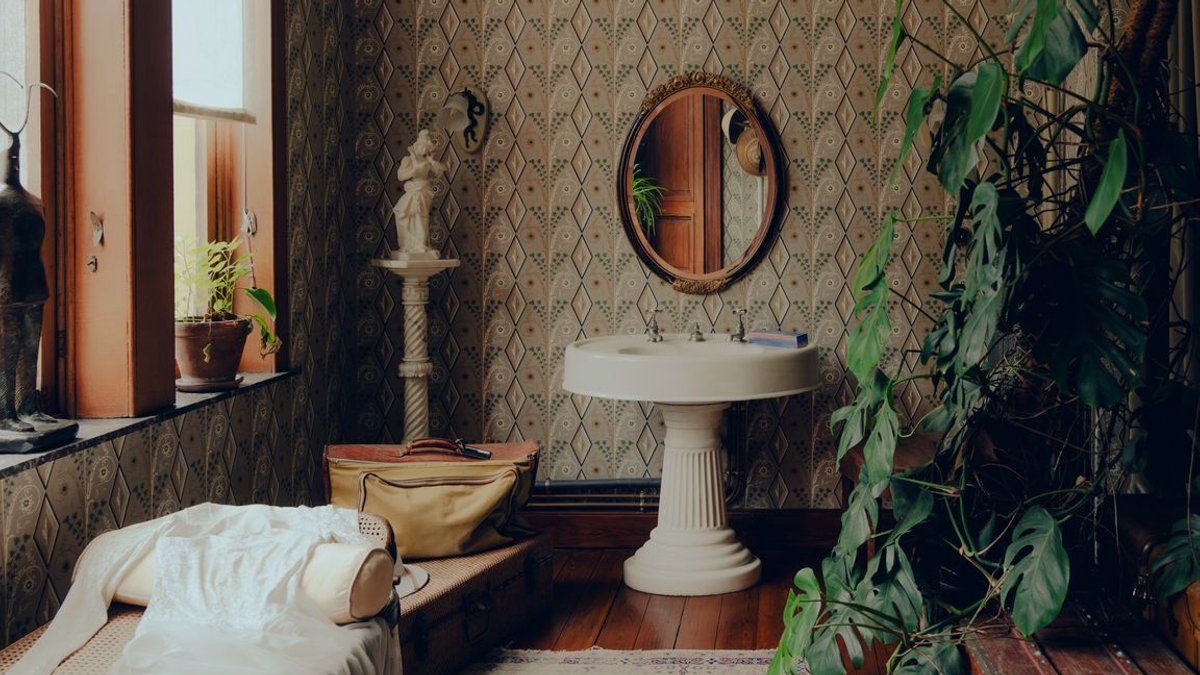
A study of the paints in the house found traces that were typical shades for the 19th century: reds, greens, and browns. The specialists removed layers of paint and wallpaper to show the successive décors over the past century. Françoise Aubry, then curator of the Horta Museum, sourced appropriate objects, utensils, and items of hardware to add interest to the interior.
In the lower-ground-floor kitchen, the shelves were filled with Tournai porcelain, stacked wicker baskets, and hung copper pans from the walls. For the last 20 years, Maison Autrique has been open to the public and hosted countless exhibitions, talks, and events, paying homage to the Belgian architect and the beginnings of Art Nouveau.
As a reward for his friendship and championing of a brave new vision, the Autrique name will always be indelibly linked with this stylistic sea change. With many of Horta’s buildings forgotten or demolished, Maison Autrique and its exemplary restoration demonstrate the lasting impact of Art Nouveau, a legacy that continues to inspire and influence architecture today.
Legacy of Art Nouveau
Maison Autrique’s restoration is a prime example of how preservation efforts can help maintain the integrity of historic buildings. The municipality of Schaerbeek’s efforts to restore the building have ensured that it remains a vital part of the community, hosting various events and exhibitions that celebrate the life and work of Victor Horta.
The building’s history is a fascinating story that spans over a century, with various owners and transformations that have shaped its current state. From its humble beginnings as a family home to its current status as a museum and event space, Maison Autrique has played a significant role in the development of Art Nouveau and its continued influence on architecture.
Victor Horta’s contributions to the development of Art Nouveau are still celebrated today, with his buildings remaining some of the most iconic examples of the style. His work continues to inspire architects and designers around the world, and his legacy is a sign of the power of innovative design and creative vision.
Read Also: Francis David praises the outsider artist’s quiet genius
The preservation of Maison Autrique is a significant achievement, one that has required careful planning and execution. The building’s restoration has been a long and complex process, involving the removal of layers of paint and wallpaper to reveal the original décor. The end result is a building that is both a faithful representation of its original state and a lively, living space that continues to evolve and adapt to the needs of the community.
As the years pass, Maison Autrique remains a beloved and integral part of the community, a symbol of the enduring legacy of Art Nouveau and the creative vision of Victor Horta. The building’s story is one of transformation and renewal, a sign of the power of preservation and restoration to bring new life to historic buildings.
Enduring Influence Today
The legacy of Victor Horta and the Art Nouveau movement continues to inspire and influence architecture today. The style’s emphasis on nature-inspired, decorative unity and technical innovation has had a lasting impact on the development of architecture, and its influence can be seen in buildings around the world.
Maison Autrique is a prime example of the enduring legacy of Art Nouveau, a building that continues to captivate and inspire visitors from around the world. Its restoration is a sign of the power of preservation and restoration, and a reminder of the importance of protecting and preserving our cultural heritage.
Today, Maison Autrique stands as a lively and living example of the Art Nouveau style, a building that continues to evolve and adapt to the needs of the community. Its story is one of transformation and renewal, a sign of the power of creative vision and innovative design.


