
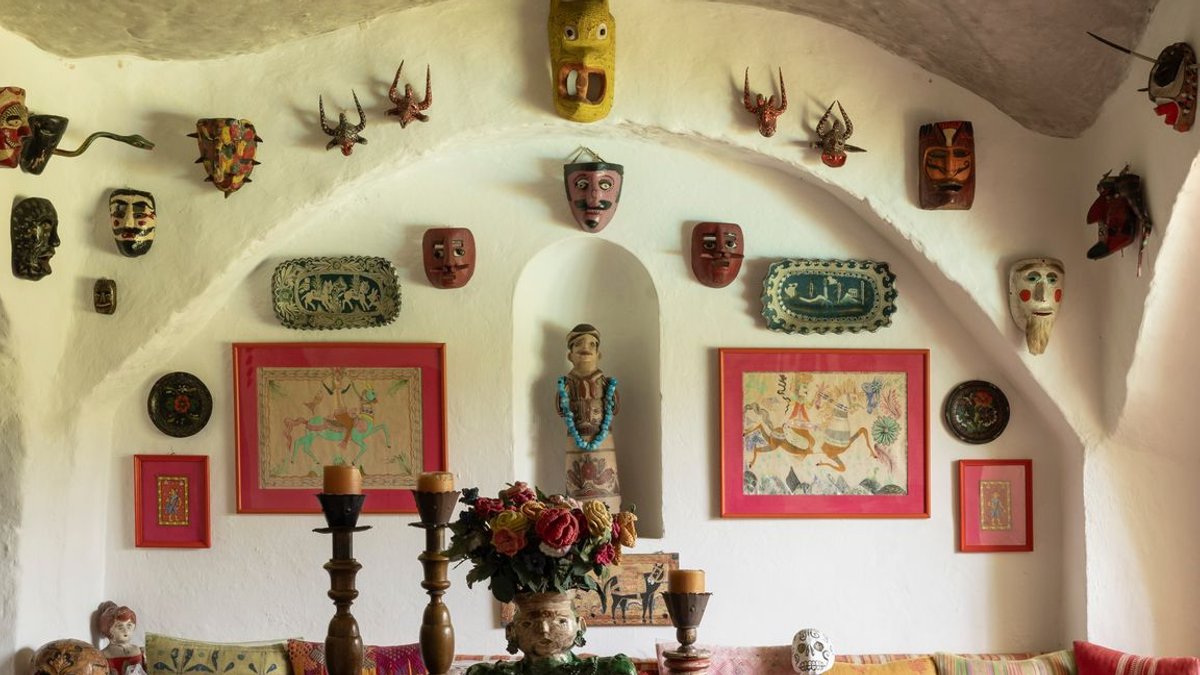
Cuernavaca, a city one hour south of Mexico City, has long attracted outsiders fleeing the intensity of European or American metropolises. Locally called Cuerna, it became a retreat for artists and intellectuals in the mid-20th century. By 1959, heiress Barbara Hutton had already constructed a Japanese-inspired residence there. Two years later, collector Robert Brady acquired Casa de la Torre, a 16th-century Franciscan monastery that embodied the city’s nickname, “the city behind walls.” The estate, once a gathering spot for international figures, remains unassuming today. Its three-story tower, originally added by a bishop for astronomical studies, rises above a burnt-orange wall.
Inside, carved cedar doors frame an entrance leading to one of Mexico’s most distinctive homes. The interior holds over 1,300 objects Brady gathered during his annual travels, blending fine art with folk traditions. Guests like Rita Hayworth, David Hockney, and Maria Callas once wandered its halls, drawn to the eclectic mix. The building’s origins trace back to Catedral de la Asunción de María, one of Mexico’s oldest cathedrals, constructed in 1525. After the revolution, the government sold the monastery, and Brady transformed it into a space for creativity and leisure.
He repurposed the colonial stone courtyard for tertulias—social gatherings where debates over wine often turned into spontaneous performances. The architecture mirrors Brady’s own flair: a fusion of colonial design, folk art, and religious imagery. Diego Rivera’s works hang alongside Navajo rugs, Cherokee masks, and a Moroccan hunting horn, each piece valued equally. Brady’s upbringing in Iowa in 1928 shaped his unconventional path. He abandoned his family’s trucking business to study art in Venice before settling in Cuernavaca, which he called his “spiritual home.” He funded the monastery’s restoration, adding a pool and a new wing for a studio and guest bedroom.
Read Also: Horta Unveils First Art Nouveau Building
His collecting philosophy was influenced by Albert C. Barnes, founder of the Philadelphia Barnes Foundation. Barnes’ “ensemble” displays—pairing medieval sculpture with kitchen utensils—inspired Brady’s own approach. At Casa de la Torre, a Haitian folk art piece might adorn the bathroom alongside Talavera tiles, while beaded doves by the Mexican Huichol people rest on a Bamileke stool from Cameroon. As a cosmopolitan gay man, Brady designed the house as a sanctuary for chosen family.
He curated guest lists with the same precision as his collections, blending Broadway stars, royalty, and intellectuals. Engelbert Humperdinck and the last queen of Italy were among his visitors, alongside Rufino Tamayo, whose framed invitation to his museum opening still hangs in the house. The Yellow Room upstairs honors female friendships, featuring a portrait Brady painted of Peggy Guggenheim and a shrine to Josephine Baker. Their bond was so strong that they married in Acapulco in a non-romantic partnership.
Brady later dedicated an Orientalist-themed bedroom to Baker, filled with maximalist interiors, Persian paintings of dancers and shell niches, one holding a costume she once wore. Hand-painted ceramic figures in the cantina best capture Brady’s chosen family. Above a wraparound bench, models of Maria (his cook), Mexican comedian Cantinflas, and Peggy Guggenheim (glasses perched on her nose) sit beside a figurine resembling Brady himself. Faded party photographs add to the intimacy: there’s one of him and his Oscar-winning neighbour, Helen Hayes, grinning side by side and another from 1984 with an open-shirted David Hockney, smoking over dinner.
Read Also: New ice cream shop opens in Broadstairs
Brady’s life and home were built on privilege. The freedom to collect ethnographic artifacts and sacred ritual items reflects a rare opportunity to reimagine domestic life. The poolside loggia, where Christmas lunches were held with pre-Hispanic statues in the background, deliberately contrasted with conventional displays. Sergio Moreno, the house’s guide for 30 years, describes it as “a refuge for all”. More than a museum of objects, Casa de la Torre preserves a way of living, one where artistic exchange and friendship took precedence. Brady died in 1986 at age 58.
Four years later, the house opened as a museum. Its walls still carry the energy of his gatherings, proving how one vision could transform a crumbling monastery into a home for the unconventional. The challenge now is whether its legacy can outlast its founder. Brady’s collections, once fluid and alive, are now fixed in time, yet the house remains a living space. The caretakers must preserve not just the objects but the spirit of the place, a sanctuary where outsiders belonged and every guest felt like family.


