
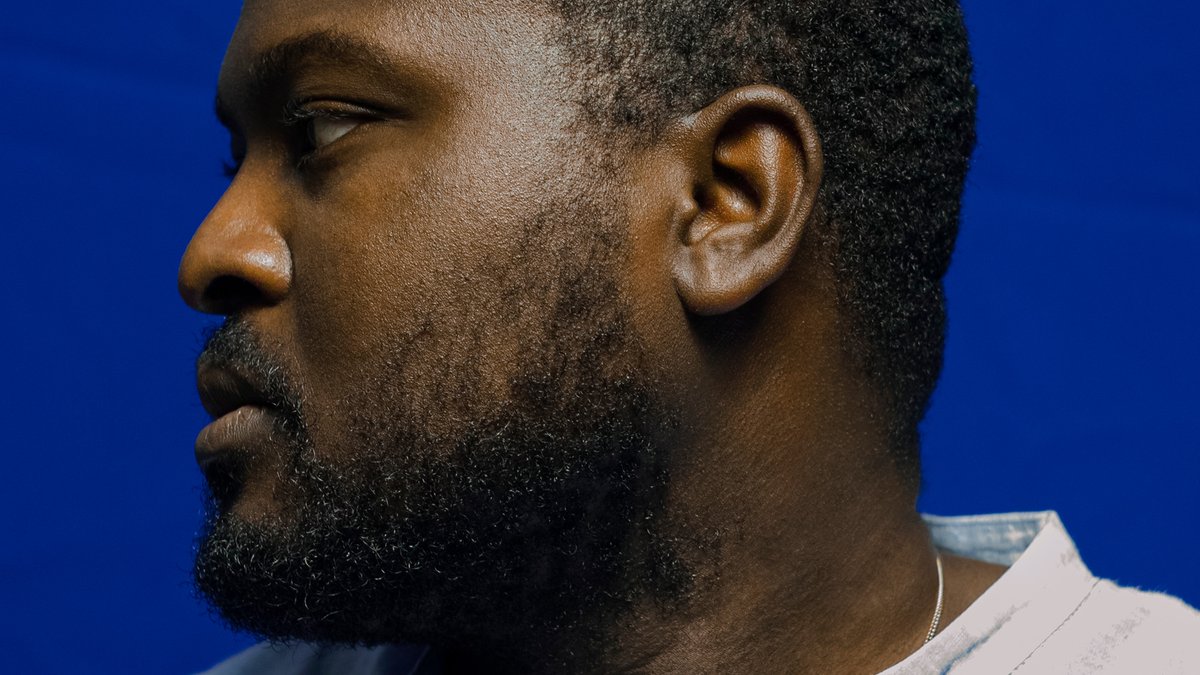
Nifemi Marcus-Bello is bringing a critical perspective on West African design to a global audience. Based in Lagos, Nigeria, the designer has recently completed projects in cities ranging from Los Angeles to London, with an upcoming solo show in Amsterdam. His work injects the industry with a fresh, forward-thinking approach that challenges standard narratives.
One installation at this year’s Milan design week tackled politically sensitive subject matter. Omi Iyọ highlighted the plight of migrants crossing from North Africa to Southern Europe. The imposing dark blue stainless steel sculpture filtered salt slowly through a small hole, functioning like an hourglass. Debuting at last year’s Design Miami, the piece was inspired by a conversation he had with a migrant.
Marcus-Bello intended the work to offer a moment of reflection amidst the chaos of the event and the world. After studying product design in Leeds, England, he returned to his hometown. He realized quickly that designing on the continent requires a specific kind of humility. The way someone would sit in London and interact with certain materials is different from how people perceive forms in Lagos.
Questions of Materiality
While Western markets often prioritize novelty, Marcus-Bello’s focus on material history suggests a potential shift toward deeper engagement with the origins of objects. If more designers adopted this investigative approach, the industry might move away from disposable trends toward more culturally resonant production methods. This could redefine how global audiences value the narrative embedded in functional items.
Related: Anya Hindmarch shares three keys to global branding
Marcus-Bello places materiality at the forefront of his process. He questions why new materials are introduced into African markets and how they alter local identity. He notes that while sustainability is a buzzword in the West, it has long been a cultural norm in Africa through the practice of reuse.
Materials hold different meanings depending on the community. For instance, he points out that in a Guyanese tribe, only the king wears gold, affecting how the material is viewed commercially. He tries to pose questions along these lines: Why do these materials exist? Do we need to avoid them?
In 2017, he started his namesake studio. The 10-person team includes highly skilled long-term collaborators, like the welder to whom he was an apprentice at age 13.
Building Trust Through Craft
Trust is essential when working with traditional craft communities. Marcus-Bello approaches these relationships as a student rather than an expert. It took him a year to build rapport with sand-casters for a project. He initially brought a secondhand car to them for repairs, which allowed him to enter the community naturally before proposing any design concepts.
Related: Nakaniwa Oasis Fuses Minimalist Design with Vibrant Interiors
This human approach led to the creation of Oríkì (Act II): Tales by Moonlight, a functional sculpture collection for Design Miami 2023. He has also worked with Benin bronze casters to introduce new textures. For his first solo US show, Friction Ridge, he introduced a silicone mold to the bronze casters, who had previously only used lost-wax casting.
His studio balances commercial work with artistic inquiry. The LM stool, produced in Lagos, was added to the permanent collection at the Denver Art Museum last year. Another piece, the M2 shelf, mimics the 19th-century Igbo wooden sculpture, Ogbom, playing with qualities of lightness and weight. He also recently released a limited edition “Selah Lamp 2.0” with a Madrid-based fabricator.
In Africa, Marcus-Bello finds there is no strict line between art and design. He emphasizes the emotional attachment to functional objects. This emotional transfer is central to his work, regardless of whether it is a commercial product or a solo exhibition piece. The designer splits his output into acts, viewing his current work as part of a larger unfolding narrative.


