
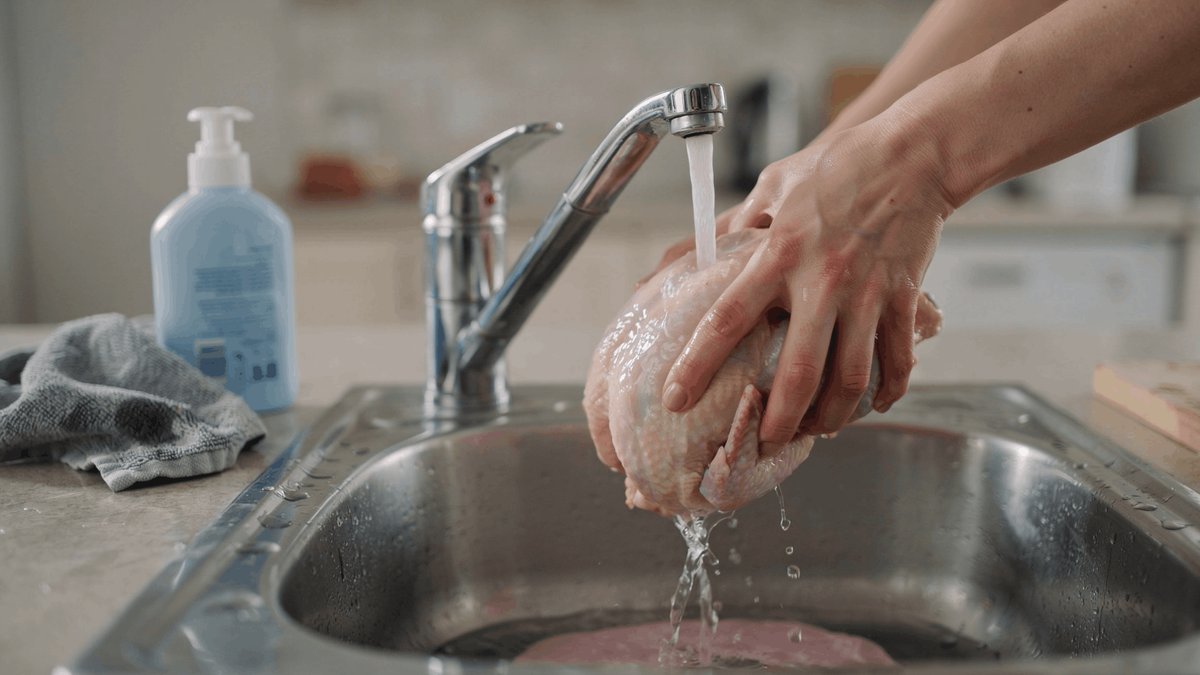
About 70% of home cooks in the U.S. still rinse raw chicken before cooking, a practice passed down through generations. Food safety experts say the habit doesn’t remove bacteria and instead spreads it across kitchens.
Salmonella and Campylobacter, two leading causes of food poisoning, cling tightly to chicken skin. Rinsing fails to wash them away. Water hitting the raw meat creates a fine spray of droplets carrying bacteria that can travel up to three feet from the sink.
A 2019 U.S. Department of Agriculture study found that 60% of people who rinsed raw chicken ended up with bacteria in their sink afterward. Even after cleaning, 14% still had contamination lingering. Worse, 26% transferred bacteria to ready-to-eat foods like salad during the same meal. The study also measured how far the spray reaches—countertops, faucet handles, spice jars, and even nearby fruit bowls. The USDA describes this as “aerosolization,” a bacterial mist settling on everything within reach.
Government testing shows about 1 in 25 packages of raw chicken sold in U.S. grocery stores contains Salmonella. Campylobacter is even more common, present on nearly all raw poultry. Together, these pathogens cause about 1.9 million illnesses annually in the U.S., with Salmonella alone responsible for roughly 420 deaths each year.
The bacteria remain invisible, odorless, and tasteless. A chicken that looks fresh can still carry enough pathogens to sicken a family if they land on the wrong surface. Rinsing doesn’t reduce that risk—it increases it.
Food safety authorities, including the USDA, CDC, and FDA, agree on a few key steps that take less than a minute and don’t involve running water.
Skip the sink entirely. Transfer the chicken directly from the package to a pan or cutting board. If the surface feels too wet for a crisp sear, pat it dry with a paper towel—then throw the towel away immediately. Don’t set it on the counter.
Wash hands with soap for a full 20 seconds after handling raw chicken or its packaging. A 2019 USDA study found that 31% of people who didn’t rinse still contaminated their food, mostly because they rushed or skipped handwashing.
Related: Important tips to know when renting out your house
Clean any surface the chicken touched—cutting boards, knives, countertops, faucet handles—with hot soapy water, then follow with a kitchen sanitizer. The USDA recommends this for everything, including cabinet knobs grabbed with raw-chicken hands.
The only reliable way to kill bacteria is heat. Cook chicken to an internal temperature of 165°F (74°C), verified with a meat thermometer. Color, clear juices, and firmness aren’t trustworthy indicators. If the chicken has visible debris, like a stray feather, wipe it off with a damp paper towel and discard the towel. If it smells off, throw it out—no rinse will make it safe.
Lemon juice, vinegar, and saltwater rinses don’t work either. The USDA warns they spread germs just like plain water, without killing bacteria. Their guidance is clear: the less contact raw chicken has with water before cooking, the safer the kitchen stays.
Most people who rinse do it out of habit. The shift away from the practice isn’t about shaming home cooks—it’s about replacing an outdated step with one that actually reduces risk.
The sink isn’t where the cleaning happens.
The pan is.
Even Julia Child, who famously rinsed her chicken on national television, was working with poultry from a different era. Today’s chicken doesn’t need the same treatment. What it needs is a thermometer and a little less water.


