
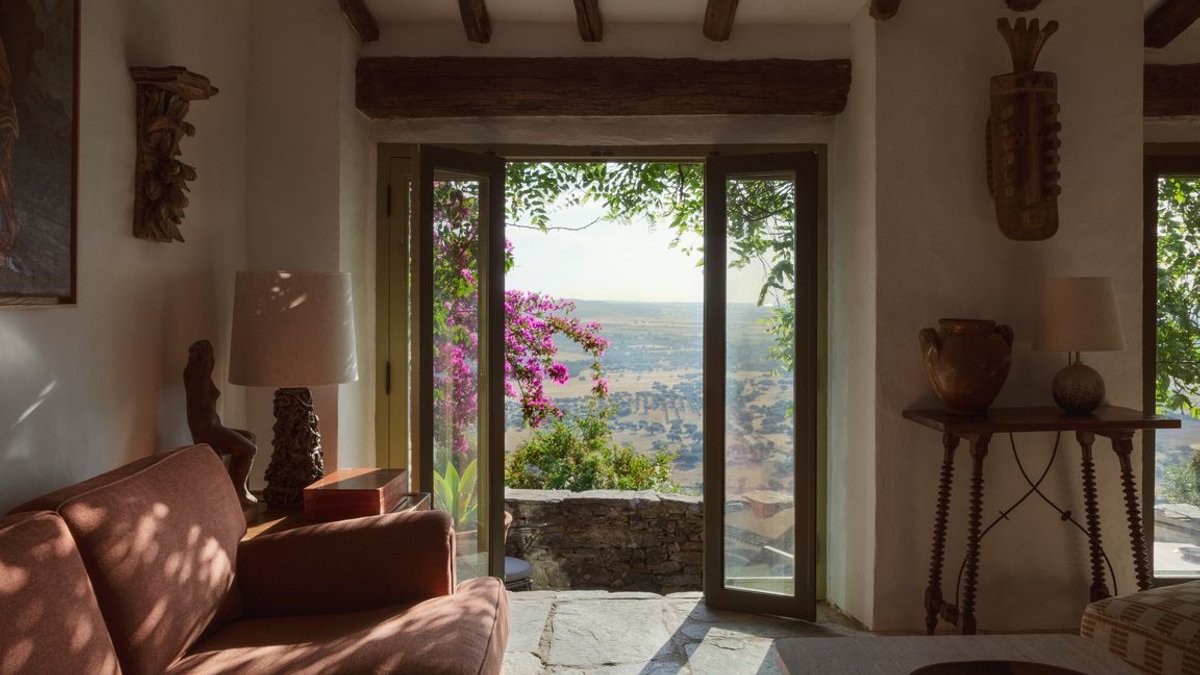
Alexandra de la Poype Dubail recalls the sense of belonging she felt in Monsaraz, a feeling that was immediate and different from what motivated her to build her first home in Portugal, Casa do Mar, years earlier. The schist beneath her feet, the scent of rockrose, and the light that filters through the day all contributed to this feeling.
It was in 2019 that Alexandra, a former audiovisual producer and creative director, first visited Lisbon’s Barracuda Interiors, a shop-gallery founded by French designer Alexandre Neimann. The two met and experienced an instant rapport, bonding over their enthusiasm for art, craftsmanship, and the Portuguese spirit.
Alexandra entrusted Neimann with bringing her first dream in Portugal to life, Casa do Mar, a very personal project that brought together her collection of marine objects, tapestries, and family heirlooms with pieces found online. She admired Neimann’s ability to juxtapose furniture from different eras, vintage pieces, unique objects, Portuguese ceramics, and his own creations.
The meeting between Alexandra and Neimann was enough to convince her to work with him, and their collaboration resulted in a beautiful home that reflected Alexandra’s personal style. As she said, ‘My world and Alexandre’s were perfectly in tune; I admire his ability to juxtapose furniture from different eras, vintage pieces, unique objects, Portuguese ceramics and his own creations.’
Related: Maritime Innovation Center to Lead Blue Tech Growth
Just as Alexandra had fallen in love with the charm and natural beauty of Comporta, a new elite of travellers had also found in Comporta a certain boldness and enchantment, making this destination one of the most sought-after in Europe. This change heightened her desire to continue exploring the Alentejo, and she eventually discovered in the stone walls and megalithic monuments of Monsaraz a poetic simplicity that spoke to her.
In 2021, the process of refurbishing a stone house in Monsaraz began, once again in collaboration with Neimann, who took full charge of the interior design and architecture of the private residence. The French designer sought to strip away all unnecessary architectural clutter, promoting greater fluidity between the different interior areas.
The reconfiguration involved removing walls and altering the layout of the bedrooms and bathroom, enhancing not only the sense of space but also the comfort of the entire house. The floors of the living room and kitchen are clad entirely in Portuguese tiles produced in São Pedro do Corval, highlighting the beauty of the vernacular materials.
For Neimann, the main objective has always been to erase his own presence, creating the illusion that the house always existed exactly as it stands today. He incorporated objects he designed himself, such as the ‘Brejos’ and ‘Sintra’ lamps and the living-room rug, produced in the village of Arraiolos. The house is filled with beauty, from the relaxed bath to the floors and walls that showcase the region’s character.
Related: New dining pavilion opens at Bandon Dunes
The owner’s love for the Alentejo is evident in her words, and the house in Monsaraz is a reflection of the region’s beauty. As she said, ‘There are two places that evoke the same feeling in me: that of a setting older and more powerful than ourselves. Stone and water, silence and movement.’ The silence in Monsaraz is a reminder that, in a world where excess and noise are practically omnipresent, we need its absence to learn to listen again.
In the midst of this serene setting, Alexandra’s house stands as a peaceful retreat, a place where one can escape the chaos of everyday life and find solace in the beauty of nature. The house, with its schist walls and Portuguese tiles, is a reflection of the region’s rich history and culture, and it continues to inspire those who visit it, much like a well-designed space can have a meaningful impact on its occupants.
She values the simplicity and authenticity of the Alentejo, which is why she chose to refurbish a stone house in Monsaraz rather than building a new one. This decision allowed her to preserve the history and character of the house, while also making it her own.
Today, Alexandra’s house in Monsaraz is a sign of her love for the Alentejo and its people. It is a place where she can escape the stresses of everyday life and connect with nature, and it continues to inspire those who visit it with its beauty and simplicity.


